Player's guide
Pitwall — Player's Guide
What Pitwall is
Pitwall is a single-seater racing team manager. You are not driving: your place is behind the pit wall. Two cars to run, a team to build from nothing and a budget you have to drag out with your teeth. On Sunday every choice you made during the week is reflected directly on the stopwatch.
A career is played on a twelve-division ladder. You start at the bottom — club racing, no wind tunnel, an old car and a lot of elbow grease — and you climb. Every division is stricter than the one below: the number of races changes (8 at the bottom, 24 at the summit), so does the money, and so does which systems are switched on at all. The cost cap, the component quotas, wind-tunnel correlation and politics exist only at the upper rungs. At the end of a season two, three or four teams go up and as many come down; the closer to the summit, the fewer places change hands. When you are promoted you take everything you have built with you: the buildings, the people, the drivers.
The thing to understand before anything else: you never see the truth. No screen in the game reads the real data. Everything you read — downforce, a tyre's degradation, a driver's market value — is an estimate: the true number plus an error. How wide that error is depends on how closely your tools match reality, on how good your engineering department is, on how much data you have gathered at this circuit, and on how well the driver reports what the car is doing.
And a team's error is biased in one direction, not resampled every time you open a screen: if your tools lie, they lie the same way every time. You can develop with total confidence in the wrong direction for half a season. The rival teams read exactly the same imprecise estimates you do: they cannot cheat, by construction.
There is no perfect choice. Every decision has a price and opens a trade-off.
First steps: founding the team
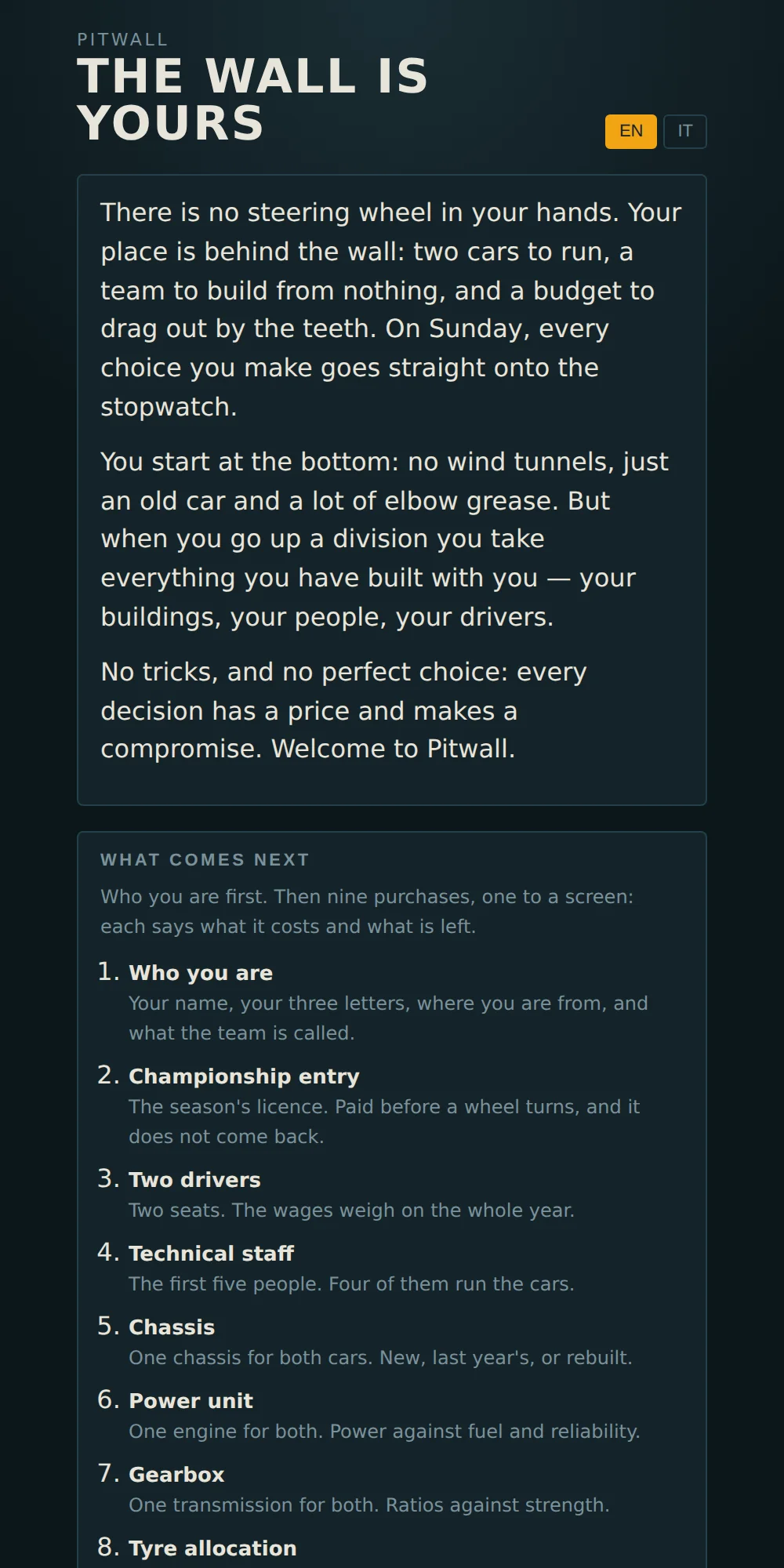
A new career starts with who you are — name, three-letter code, nationality and what the team is called — and then with nine purchases, one screen each. Every screen says what it costs and what is left in the bank, and that balance is the same one the Finances sheet reports.
You start at the foot of the ladder with a midfield team: high enough to learn, low enough that every euro counts.
| # | Step | What it decides |
|---|---|---|
| 1 | Championship entry | The season licence. Paid before a wheel turns, and it does not come back. It unlocks the driver market, the staff paddock and the calendar. |
| 2 | Two drivers | Five profiles, you pick two. What differs is not raw speed but driving style, consistency and the way they win. The salary weighs on the whole year. |
| 3 | Technical staff | The first five people. Four of them work on the cars. Staff decide how fast the car improves and what strategy reaches the radio. |
| 4 | Chassis | One only, for both cars. New, last year's or rebuilt: condition, performance and headroom. |
| 5 | Power unit | One supply for both. Not just power: how many units they give you and how much they have already run. |
| 6 | Gearbox | A separate decision from the engine: ratios against robustness. The only part on this list that can be cheap and be bought twice. |
| 7 | Tyre allocation | The weekend's sets, shared by both drivers. More sets = more strategies and a whole Friday to learn the car; the minimum gets you out there knowing nothing. |
| 8 | The base workshop | The van: tools, spares and the bench you work on. The only place a part can be repaired. |
| 9 | The base hospitality | The caravan: where drivers and staff eat, rest and talk to each other. |
The four technical choices are one each for the whole team, as in top-level racing: one chassis, one power unit, one gearbox, one tyre allocation — and what you buy is what you race all season.
On staff there is no ideal hire, only trade-offs to bet on. The four groups on offer say plainly what they buy:
- People with stripes — they can run a weekend from the day they arrive, they are close to the most they will ever give, and they charge for it.
- A year of graduates — cheap, motivated and unprepared. In three seasons it is the strongest team on this list; this year it is the weakest.
- Built around the track — race engineers, mechanics and a pit crew. Weekends run smoothly and the car stops improving.
- Built around the factory — aerodynamicists, designers and the simulator. The car grows all year and the weekends are a mess.
Technical staff sign multi-year deals: replacing one mid-season costs more than replacing a driver.
The pit box is not a level, it is a list of objects the team owns. Each costs once, takes room in the truck at every race, and decides something on Sunday: build-up hours, stationary time, how well the setup is executed, how tired the mechanics are or how consistent the driver is.
The season and the calendar
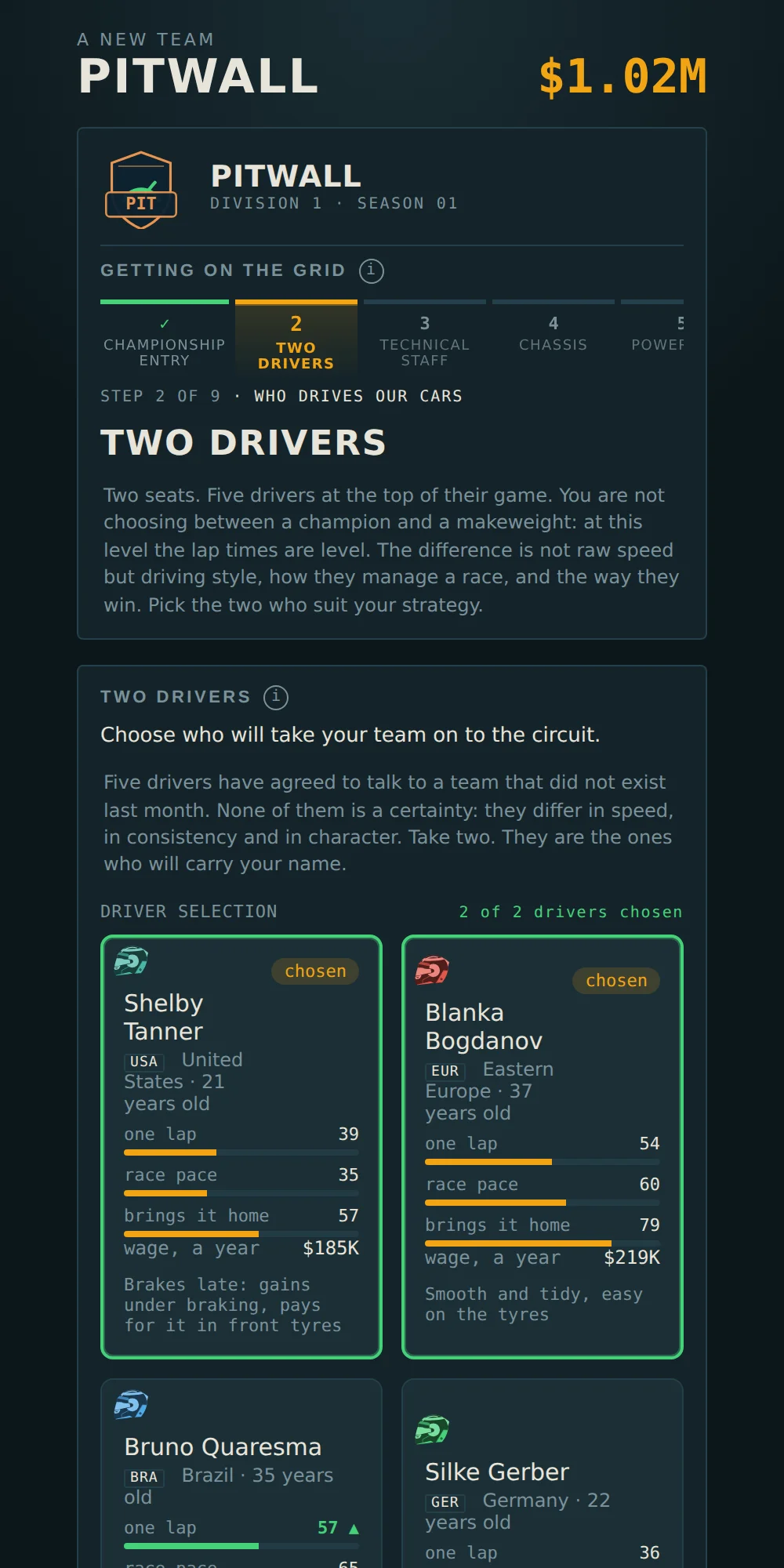
Career time advances in days, on a single clock. The calendar is not hand-written: it is generated from the circuits' own geography, so back-to-backs and long-haul blocks fall out of where the venues actually are. The season opens in the first week of March and closes in the first week of December at every rung of the ladder: a division with fewer races does not finish in September, it spreads them better through the same window.
A race weekend consumes real days, and this is what changes how you plan:
The factory's real deadline is not race day: it is the day the truck leaves. A part finished after that date does not race, however good it is. The calendar lists shipping deadlines separately for exactly this reason.
Between races you work. The technical department's hours are split across development programmes, the facilities run (wind tunnel, CFD, model shop, simulator, autoclave, machine shop, dyno), parts are built or repaired, contracts mature, negotiations open and close. Everything that matures over time is a dated entry on the same calendar: advancing a day means running whatever is due today.
Winter is the densest part of the year. After the last race, in this order:
- the season debrief
- the accounts close
- the audit result
- the market window opens
- the homologation deadline
- the new car launch
- winter testing — the federation publishes the venues, a team cannot choose its own, and they are picked from circuits with a low chance of rain
Then the table is settled: two, three or four teams go up and as many go down, according to your rung's rule. And it starts again — with the entry fee to pay once more, because a licence is good for one season.
The race weekend
A normal weekend has six sessions before the race; a sprint weekend has seven and almost no practice.
| Session | Length | Normal format | Sprint weekend |
|---|---|---|---|
| FP1 | 60 min | yes | yes |
| FP2 | 60 min | yes | — |
| FP3 | 60 min | yes | — |
| SQ1 / SQ2 / SQ3 | 12 / 10 / 8 min | — | yes, 5 eliminated each |
| Sprint | short race | — | between SQ3 and Q1 |
| Q1 / Q2 / Q3 | 18 / 15 / 12 min | yes, 5 eliminated each | yes |
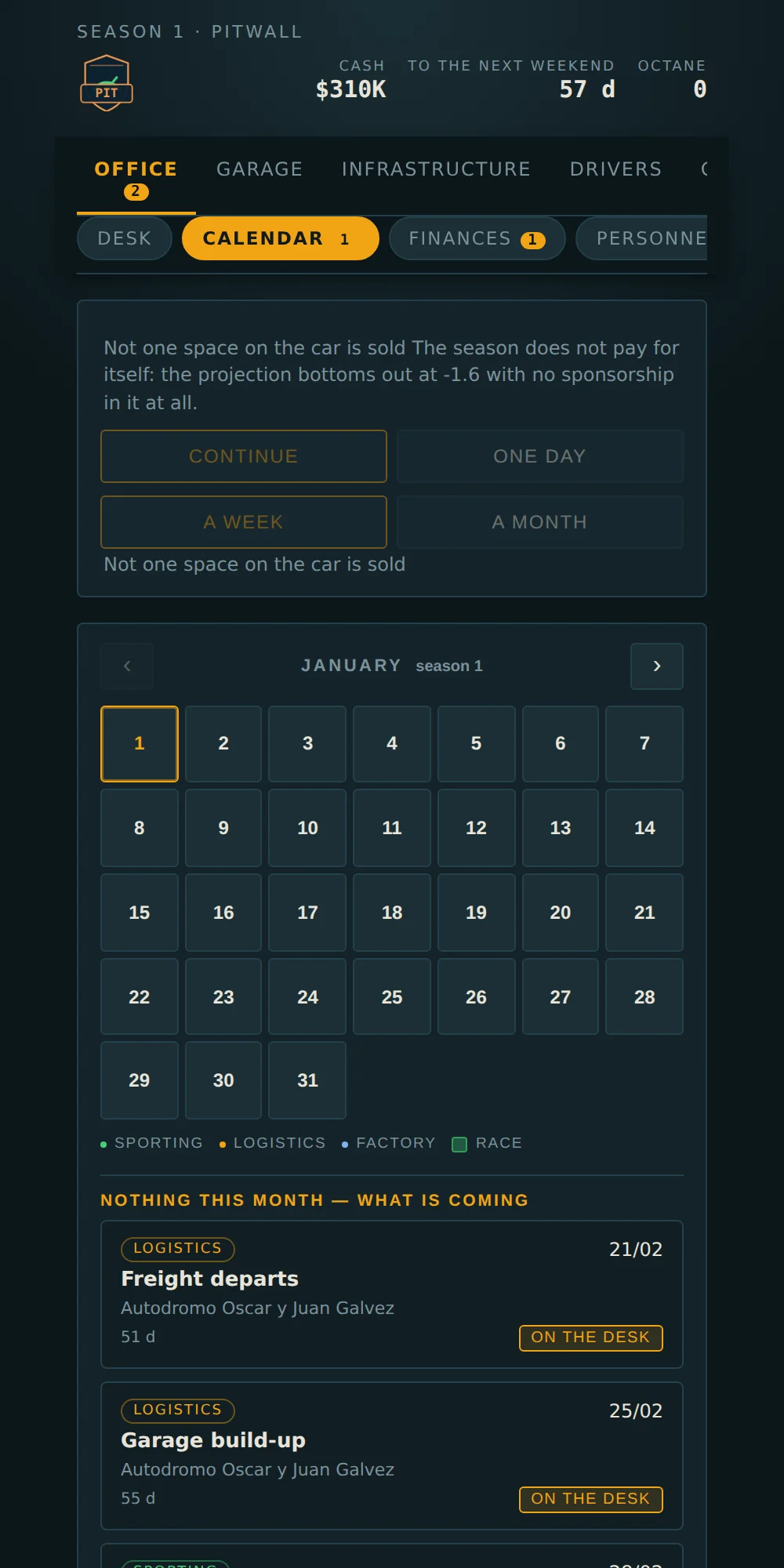
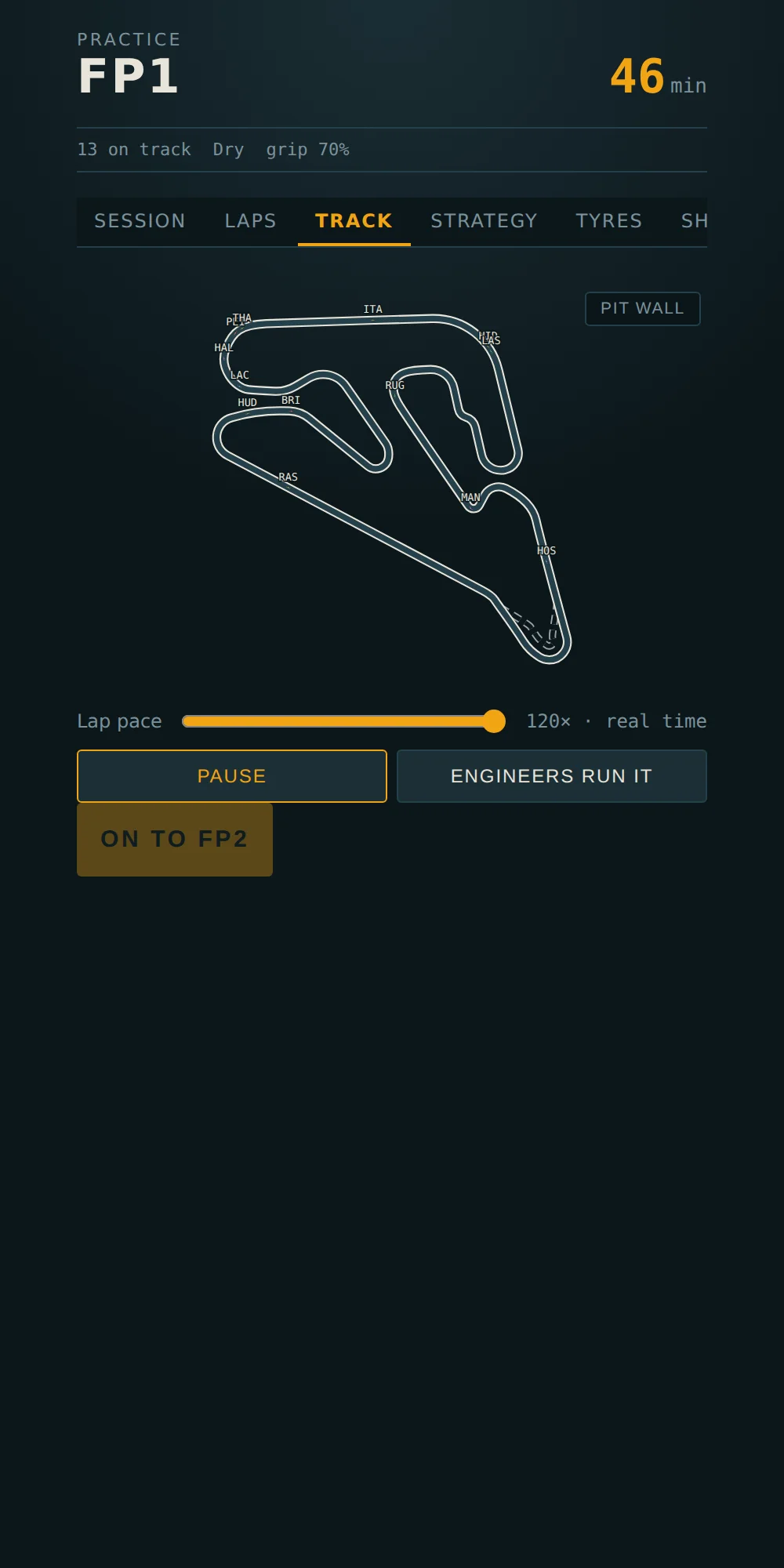
Practice is not a form you fill in. It is a session with a clock: you decide when each car goes out, on what, for how long and to do what. The track rubbers in as the hour passes, so the last runs are on a quicker circuit than the first. Traffic is real: a lap thrown away behind three other cars is a lap you do not get back.
Practice exists to find two things — the setup, and how long the tyres last at this circuit — and neither is known in advance. The engineers' advice is worth exactly as many laps as sit behind it.
FP1 must give a rookie a run in one of the two cars. The choice is made before the session starts: once a car goes out, the seat is committed until the flag.
Qualifying is the same machinery with the clock shortened and the fuel taken out. Deciding when to send the car out to find clear air is the game.
Worth knowing before your first weekend:
- Parc fermé begins with qualifying — with Q1 on a normal weekend, with SQ1 on a sprint. From there the setup and the components are what you race, and a team that turns up to a sprint with the wrong setup has nowhere left to fix it.
- The 107% rule: anyone outside the limit does not qualify, and whoever was behind them gains a place.
- Grid penalties: the first component beyond quota costs ten places, each subsequent one five, and from fifteen upwards the car simply starts from the back.
- Two different compounds must be used in a dry race. One tyre for the whole race is a disqualification, not a warning.
Between qualifying and the start come the final checks: the engineers have their say, the decisions are yours. Then the briefing with the drivers about how the race should be run — and the drivers have their own opinion — the formation lap and the lights.
On the wall: reading the race
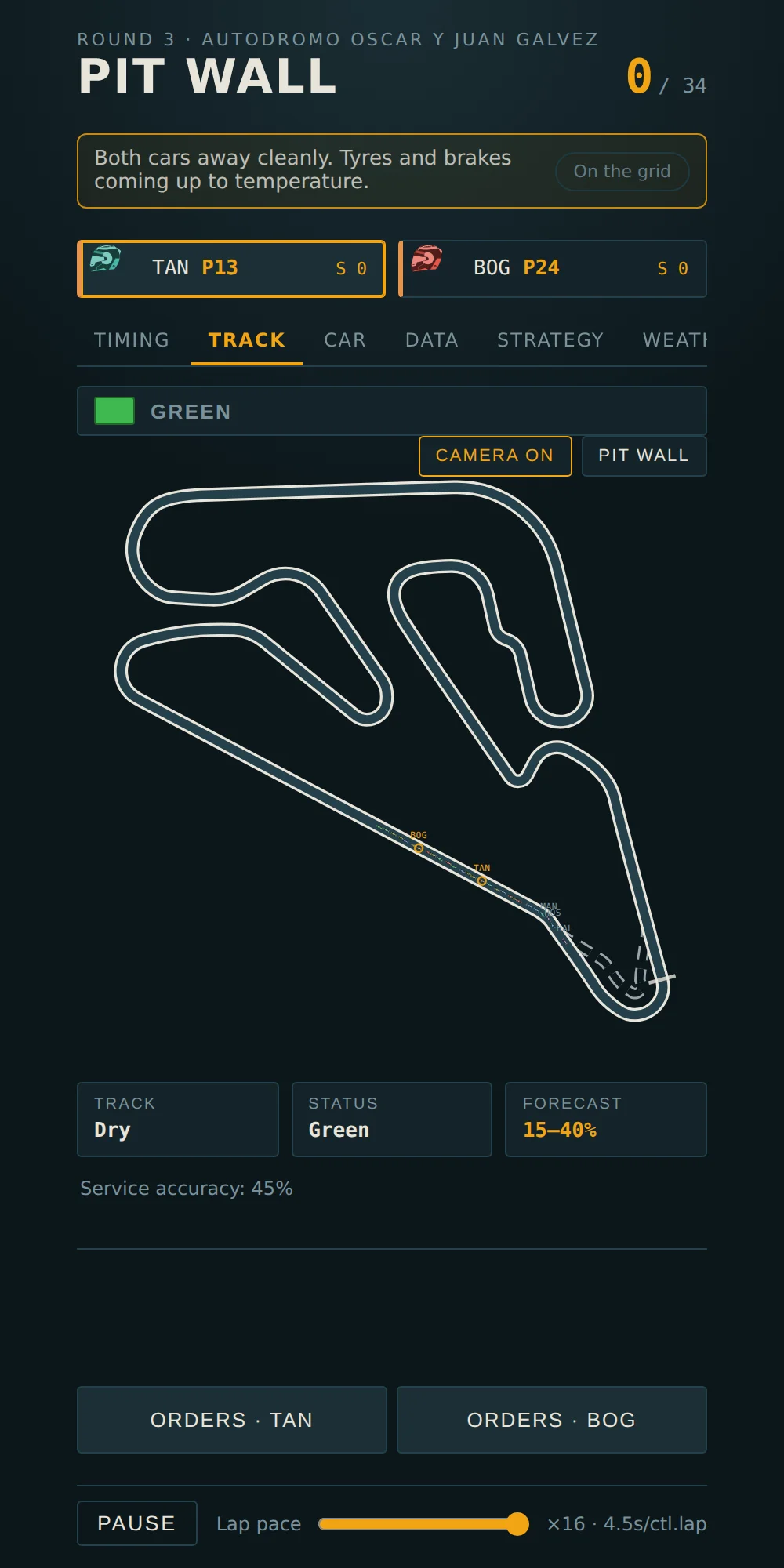
The race screen is the pit wall. There are four things to read at once.
The circuit map. Twenty cars drawn on the real layout, each with its own position clock: every car knows how many seconds ago it crossed the line and moves accordingly, in real time. The pit lane is drawn at all forty-five circuits, and a car coming in actually drives down it. The camera tightens by itself on an overtake, and on the grid at the start.
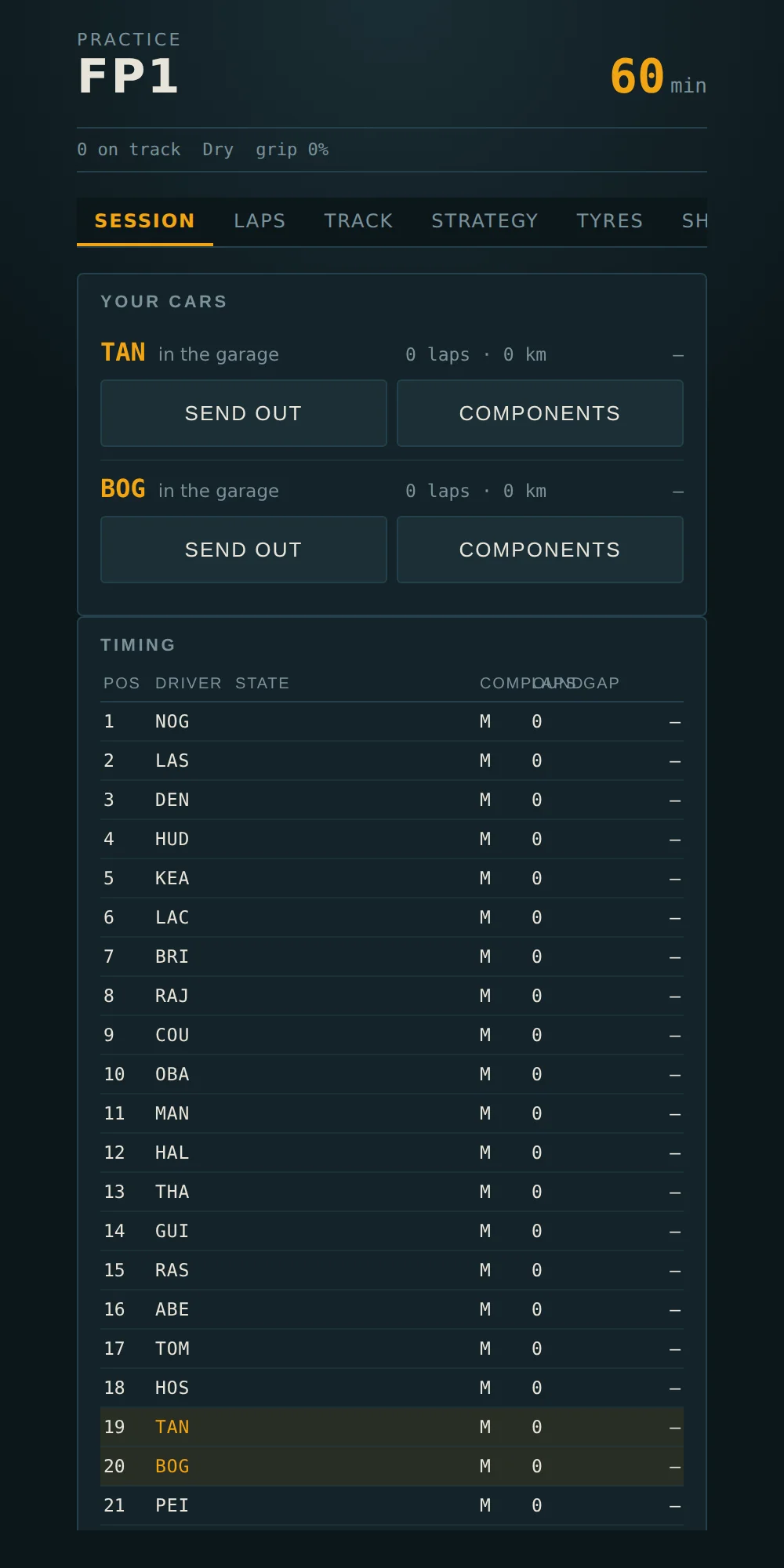
The timing tower. Position, driver, gap, tyre fitted, laps on that set, stops made, trouble in progress. It is the same list the other pit walls are reading.
Track state and sky. Rubber, track and air temperature, wind, standing water, rain risk with the forecast's own confidence. The meters are colour-coded: green fine, amber watch it, red alarm. When it rains grip falls, and there is a floor it does not go below.
The radio. Four voices talk to you during a race and they do not say the same thing, because they do not know the same thing:
| Voice | Where they are looking from |
|---|---|
| The race engineer | From the wall, with what the driver tells him: "he's losing the rear — I'd say ten good laps on this set". |
| The strategist | From the numbers: laps on the set, degradation, the next stop's window. |
| Mission control | From the factory, with the models: "the front will go before the rear". |
| The chief mechanic | From the box: who is ready, what the rivals' crews are already doing. |
When two of them disagree the game simply tells you so: you decide.
The orders you can give each driver cover pace (push, manage, save fuel, lift and coast, short-shift), the fight (attack, defend, attack under braking, hold position, swap positions), energy and engine (map up or down, deploy or save energy, protect the unit), looking after the car (cool the tyres or the brakes, manage the fronts or the rears, clear graining, off the kerbs, tiptoe) and the stop (box now, box next, extend the stint, stay out).
When a driver calls on the radio you can answer, hold the call, or let him decide.
Tyres, stops and flags
The compounds
There are five dry compounds, hardest to softest, plus intermediate and wet. Softer means faster and shorter: from C1 to C5 you gain lap time and lose about half the life. The supplier nominates three compounds per race, not all five, and how much the tyre choice is really worth depends on the division: at the lower rungs the compounds sit close together, at the summit they are far apart.
Every compound also has a temperature window and a wetness window. An intermediate on a dry track is six seconds a lap slower; a full wet is fourteen.
Sets are a fixed number for the whole weekend and they are shared by both drivers. Friday's mileage is paid for on Sunday, and after each practice session some sets go back to the supplier — the most worn first.
The race plan
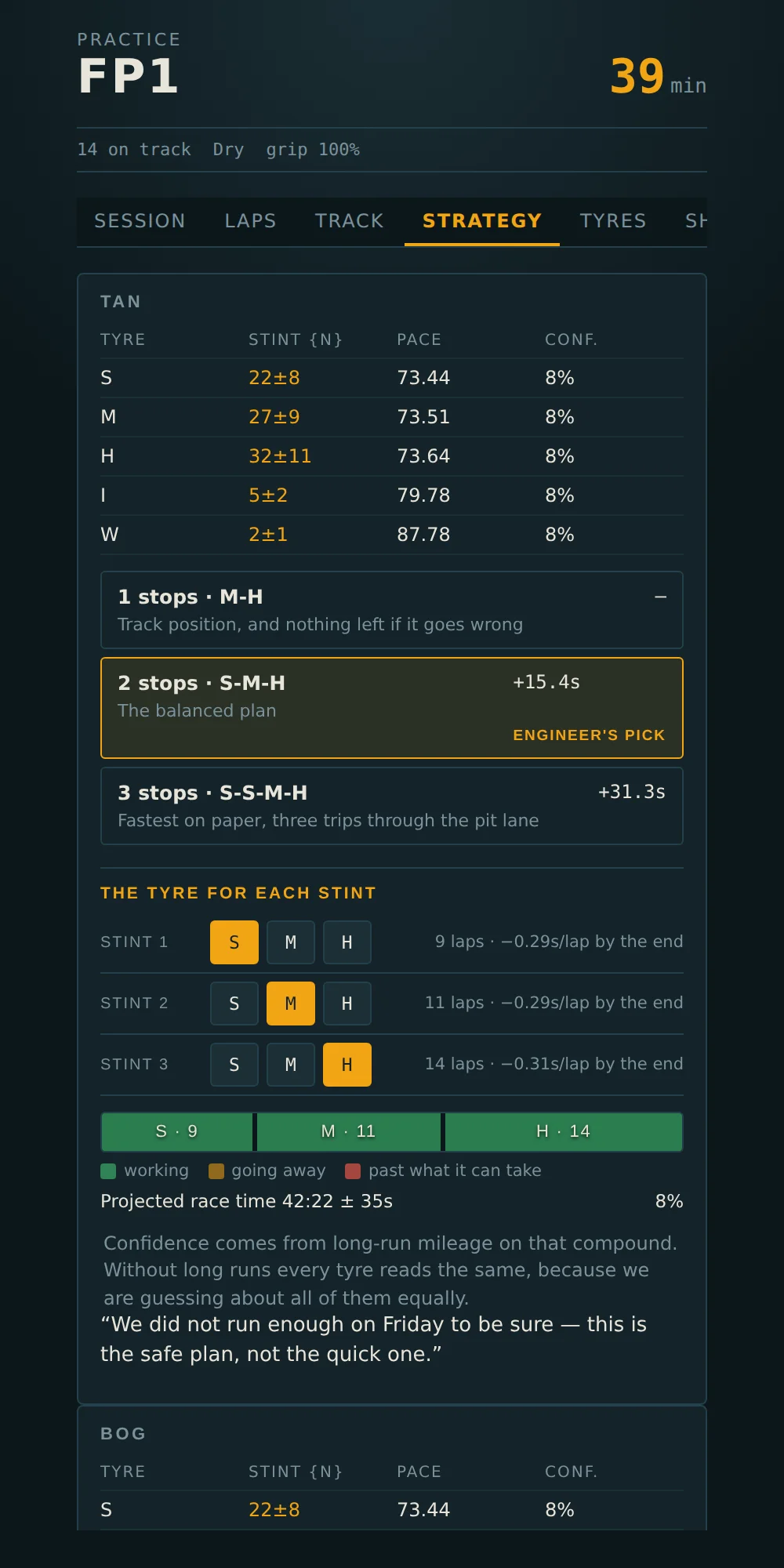
The strategy screen shows you the possible plans with the projected race time and its error band. Three recurring notes sum up the trade-off: one stop is track position, and nothing in hand if it goes wrong; two is the balanced plan; three is the quickest on paper, but three trips down the pit lane.
Every stint has a zone: in the window, falling away, beyond what it will take. The last is a serious warning: past the knee the loss is no longer proportional, so it will be much slower than the bar suggests, or it will not get there at all.
The plan's confidence comes from the race-pace laps you have run on that compound. With no race pace every tyre reads the same, because you are guessing equally on all of them. That is what makes Friday matter.
For each stint you also decide how hard to push: save them, normal, push.
The stop
The call and the stop are two different things: when you call, the crew comes out, but the stop happens when the car actually reaches the pit lane. Total time is entry + stationary + exit, and the two transits belong to the circuit, not to the team: the only column that is yours is the stationary time.
A stop can go wrong in specific ways: jammed wheel gun, stuck jack, unsafe release, stacked behind your team-mate, held for traffic, repairs. In the box you can also change the nose (it costs seconds), trim the front wing and move the brake bias.
Calling a driver in off-plan replaces the stops still scheduled: the rest of the race is decided again when he rejoins.
Flags and stewards
A safety car is not a multiplier on lap times: it is a procedure, and each of its steps lasts laps and is either an opportunity or a trap.
While the safety car is out a stop costs roughly half of what it normally would: that is where races turn over. A virtual safety car is a different thing: a delta the driver must hold, with no bunching at all. A red flag suspends the race with the cars in the pit lane.
Stewards work up a ladder, not in one blow. Track limits: warning, then black-and-white flag, then five seconds. Causing a collision: five seconds, ten, drive-through. Ignoring flags: ten seconds or a stop-go. False start: five seconds or a drive-through. Speeding in the pit lane: five seconds. At the end of the ladder is disqualification.
The team: departments and people
A team is made of departments, not of fourteen named individuals. Each has a headcount, an aggregate skill and a technical memory that outlives the people in it: the concepts the team has actually mastered. A rule change devalues part of that memory — which is why a great department is not the same thing as a permanent advantage.
The six departments and their twenty-four disciplines:
| Department | Disciplines |
|---|---|
| Aerodynamics | front, rear and floor aero, CFD, tunnel operation |
| Vehicle and mechanical | front and rear suspension, gearbox design, brakes, chassis design |
| Powertrain | internal combustion engine, MGU, energy store, PU reliability |
| Performance and data | vehicle dynamics, simulation, data analysis, strategy |
| Race team | race engineering, mechanics, pit crew |
| Management | leadership, commercial, sporting |
Every department has a board with five readings: strength, technical memory, how much of it is actually working, how many desks are covered, and what an hour of design here is worth against an ordinary department. Where somebody is missing the slot stays empty, and pressing it opens the market already filtered on that job. A pale figure is somebody already signed who is still serving notice.
Skill and experience are kept apart deliberately. A brilliant new arrival is not yet worth what he will be worth: he is still learning where things are. Each person has skill, potential, experience, settling-in, morale, age and a contract — and the sheet tells you outright whether he is still growing or is at his ceiling.
Engineers want competitive projects: somebody at a rival has a buy-out to pay, and how interested he is in you is a number you see before making an offer.
Without the right building a department produces nothing. The game says so plainly: without the facility you can hire but there is nowhere for them to work; in other cases they work, but every weekend starts from the stopwatch instead of from the simulation.
Keeping people standing
Staff and drivers have morale, fatigue and loyalty, and can end up signed off sick, on gardening leave, or in a toxic atmosphere. Every action available fixes one problem by creating another — the game writes it next to each one:
- A week off — puts him right; the department loses his contribution while he is away.
- A raise — morale and loyalty, and a line on the payroll that never comes off again.
- Overtime — a fifth more for a week, paid for in morale and health.
- Mentoring — two points of competence, bought with a month of reduced output.
The same holds for drivers, and the bill is almost always paid by the other one: a team order swaps them on track and one of them will remember it longer than the other; extra simulator buys confidence and a finer read on the car at the price of a tired driver; a lighter diary makes him happier but the sponsors notice the absence; naming a lead driver makes a number one as there can only be one.
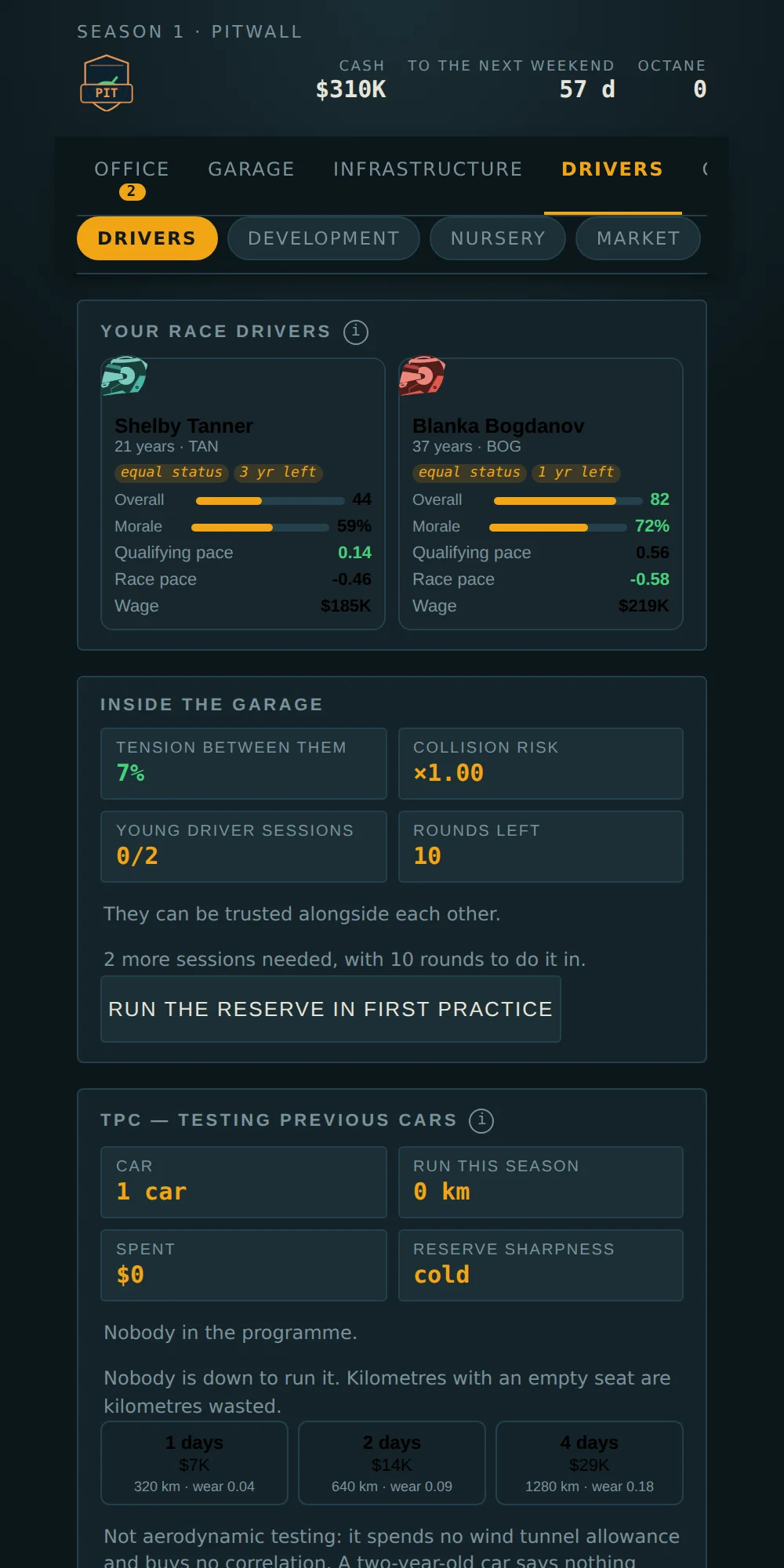
Inside the garage the tension between the two drivers and the risk of them touching are measured too.
The factory and development
You start with an office and a parts store. Everything else has to be built, and in a building that does not exist nothing gets developed. It is not a slow programme: it is an impossible one, and the development screen says so in those words.
| Facility | What it buys | Out of service for the work |
|---|---|---|
| Wind tunnel | aerodynamic development rate | 120 days |
| CFD cluster | aerodynamic development rate | 20 days |
| Model shop | aerodynamic accuracy | 30 days |
| Driver-in-loop simulator | setup accuracy | 45 days |
| Autoclave and composites | part build rate | 35 days |
| Machine shop | part build rate | 25 days |
| Powertrain dyno | power unit development rate | 60 days |
| Parts store | how much you can keep on the shelf | 10 days |
| Merchandise stand | what you can sell | 8 days |
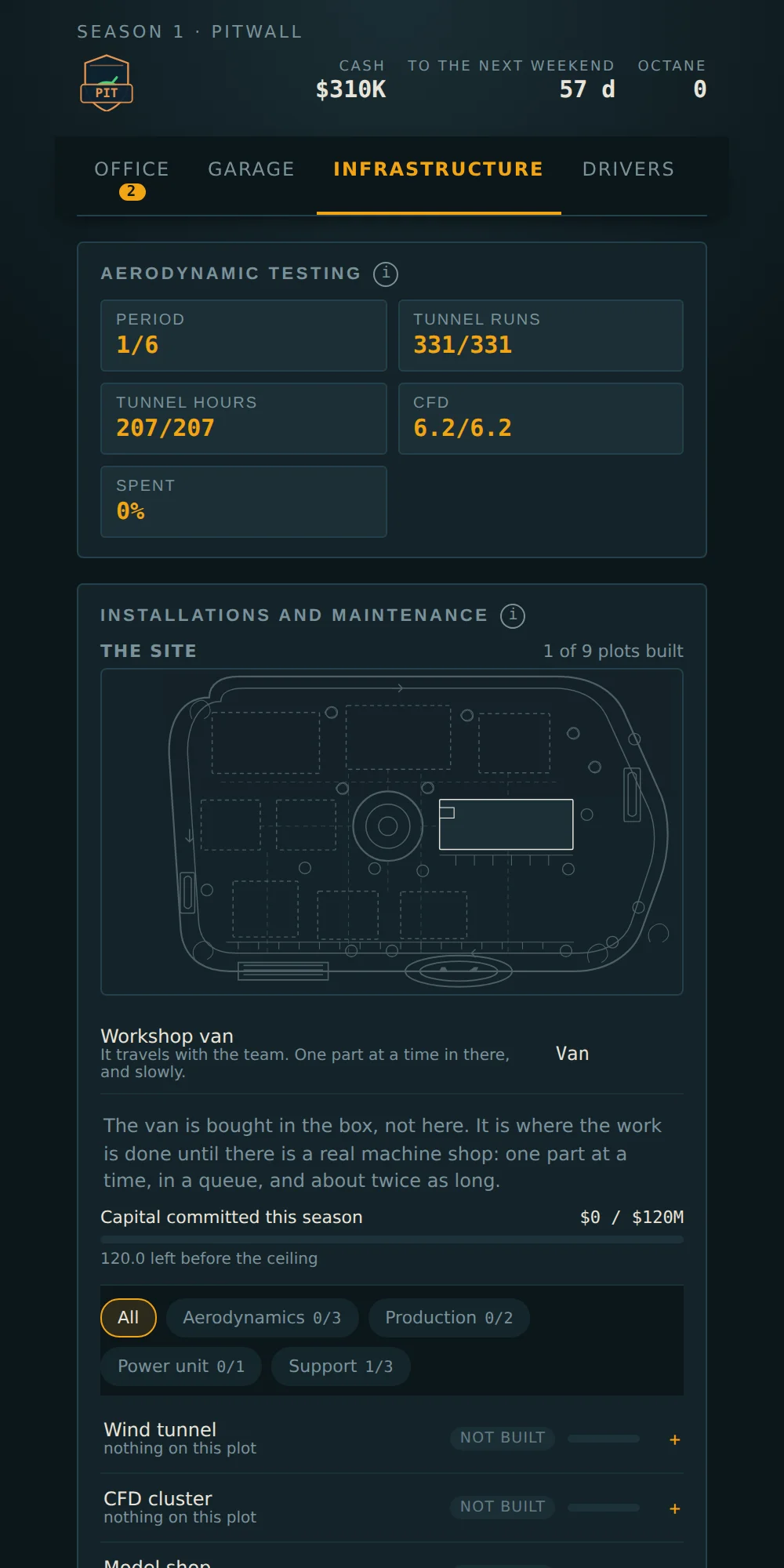
Upgrading a facility costs money and takes it out of service: improving the factory means being worse for a while. A hundred and twenty days of wind tunnel is half a season.
Three ways to pay: cash, a mortgage (a deposit today and a fixed instalment every month for the whole term, which runs through the winter and does not care which division you are racing in when it matures) or renting somebody else's. A rented hour is worth a fraction of one of your own and brings no correlation: correlation is about your instruments, not about somebody else's.
Facilities wear out by working. A service is planned downtime; putting it off is a gamble, and a failure costs several times as much at the worst possible moment. Mortgage arrears freeze all development until they are cleared: the bank comes first.
The development chain
Developing is a chain of three links, in this order:
can run at all
and on what
of the car
If the first number is zero, the other two produce nothing.
| Programme | Facility | Effect |
|---|---|---|
| Current-year aero | Wind tunnel | lap time now |
| Next-year aero | Wind tunnel | lap time next season |
| Correlation runs | Wind tunnel | nothing this weekend, everything afterwards |
| Setup work | Simulator | a sheet closer to the optimum |
| Driver training | Simulator | fewer mistakes on track |
| Power unit | Dyno | fewer technical retirements |
| Gearbox | Dyno | gearbox reliability |
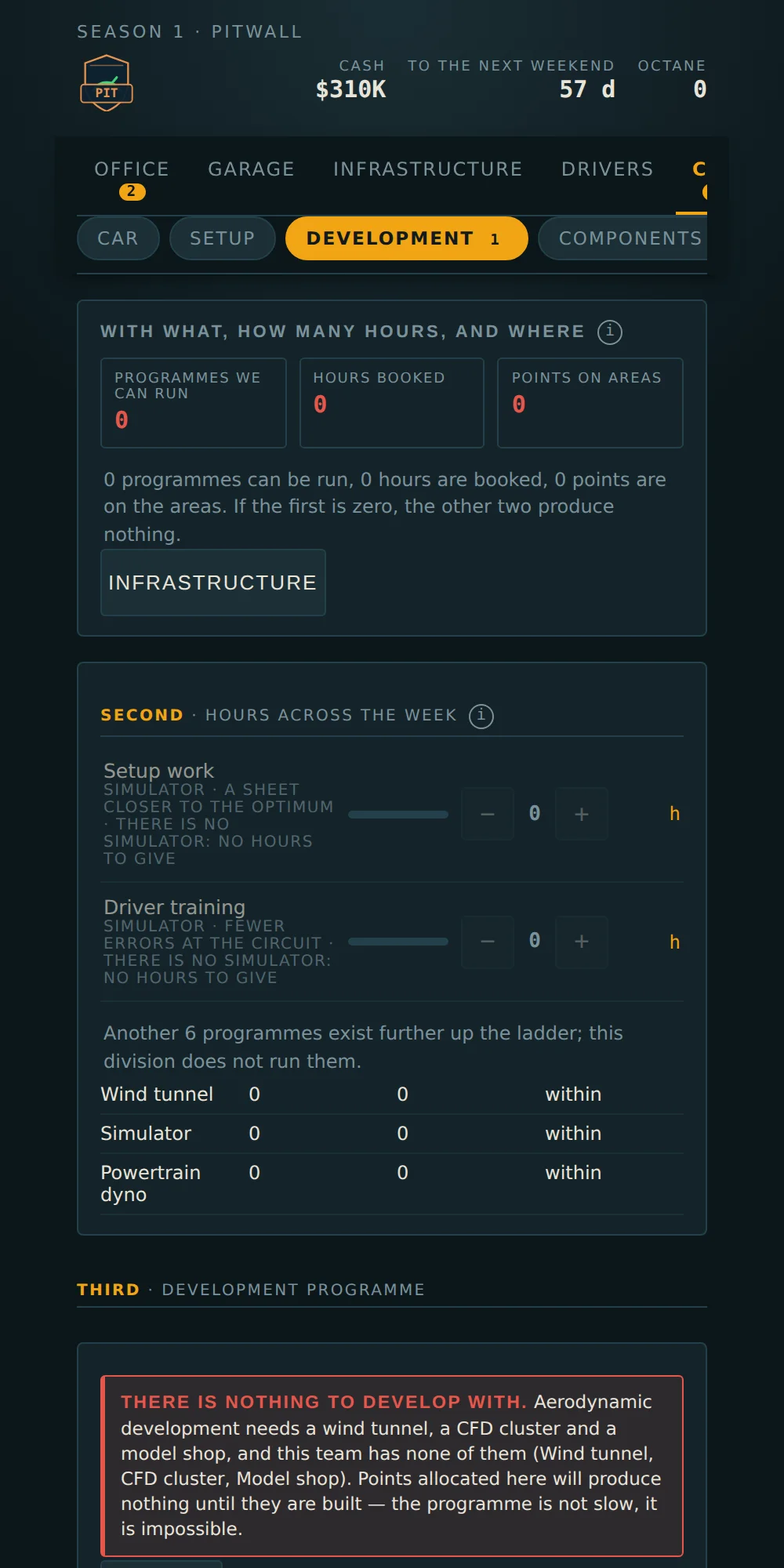
Aerodynamics, next year's car and correlation all draw on the same wind tunnel: more to one is less to another. It is the most important decision of the year, and the one that punishes anybody who spends twelve months on the car he already has.
Where we stand
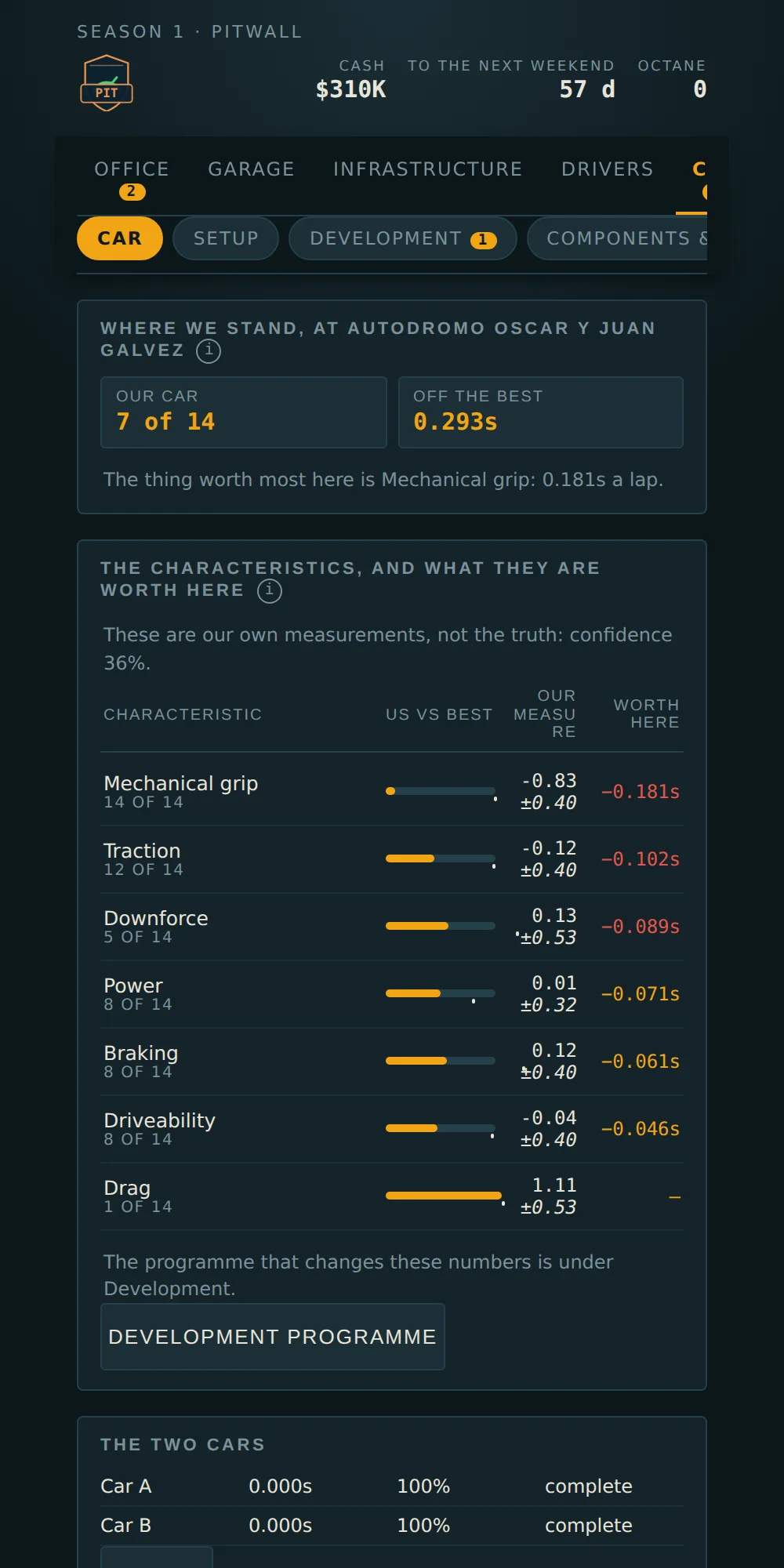
The car sheet measures seven characteristics — downforce, drag, mechanical grip, traction, braking, power, driveability — and, more usefully, what each is worth at this circuit. Being down on power is worth a lot at Monza and almost nothing at Monaco, and the sensitivity matrix knows that from day one.
Next to every value there is a band: that is how wrong you might be. These are your measurements, not the truth.
Money
Prize money arrives a year later. That is the rule that governs every career's first season: the bank and the sponsors pay for that one. And the two limits are not the same thing — the cap limits how much you can spend, the bank balance limits how much you can spend today.
Money has one scale, tied to the division: what a season costs climbs steeply towards the summit, and every fixed figure in the game goes through that multiplier. A team at the foot of the ladder does not read the premier championship's numbers. The exception is the facilities, which do not scale — a wind tunnel costs what a wind tunnel costs — except for what is sized to the crowd.
What comes in
- Championship prize fund — the division's pool split three ways: an equal share for turning up, a share on the table and a seniority share.
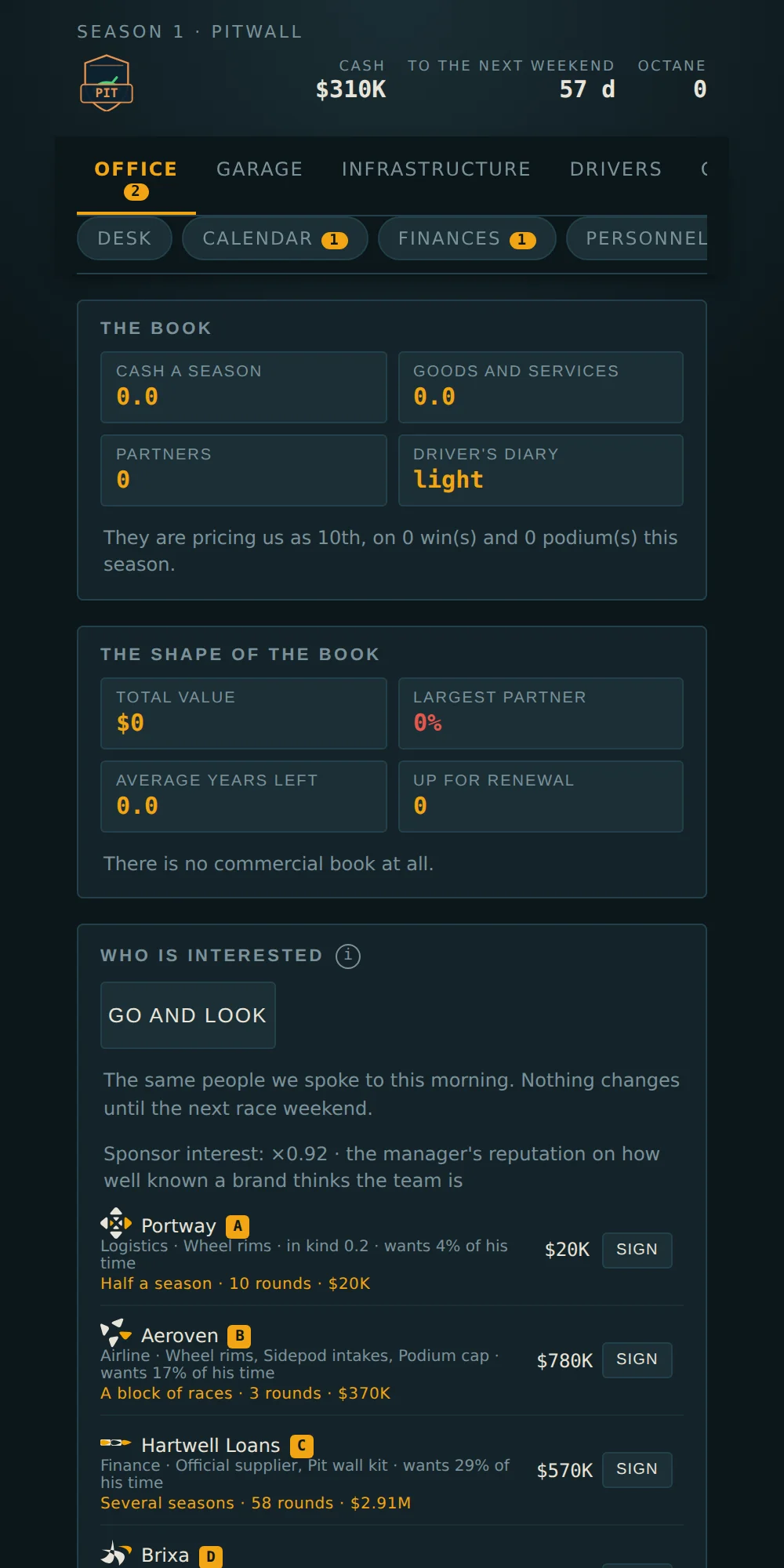
- Sponsors — fifteen industry sectors, spaces on the car, multi-year contracts with a part tied to results. Who turns up depends on where you finished: a team at the bottom is not unsponsorable, it is sponsorable cheaply, and mostly by technical partners.
- Support in kind — goods and services instead of cash. Under a cost cap it is worth more than it looks: a cost you do not carry is worth more than revenue you have to spend.
- Merchandising — needs the stand built in Infrastructure; without one there is nothing to sell from.
- Credit — overdraft, term loan, sponsor advance, shareholder loan. Each with its rate, its limit and its strain on suppliers.
Sponsors come with constraints worth reading before signing: two brands from the same sector will not coexist, some rival brands will not appear on the same car, and every contract asks for a slice of the driver's diary. When the portfolio asks more of a driver than he can give, it shows on track. Breaking a deal costs a penalty, the advance back and reputation: the market remembers, and whoever tore up a contract gets paid less by the next people along.
What goes out, and the cap
At the international and premier divisions there is a cost cap, and it is not one number. Some lines fall inside it — car development, production, race operations, logistics, engineering and operations staff, consumables — others do not: driver salaries and the three highest-paid, marketing, capital expenditure, heritage, legal, employee bonuses. Capital expenditure has its own separate ceiling, assets depreciate over several seasons instead of landing in one year, and the whole thing is checked afterwards: you can be over the line for months before anybody says so.
The entry fee is a fixed base plus a charge per point — more per point for the reigning champion — and it comes to about a tenth of a season's budget: payable out of a good year, painful after a bad one, and out of reach for a team that overspent precisely in order to win promotion. A promotion you cannot afford is a promotion that closes the team.
When the numbers do not add up
The budget screen shows the year-end forecast, spent so far, what is left, and the year's low point of cash. If it does not add up there are remedies — empty the store, sell the free spaces, stop development, let people go, ship by sea instead of by air, postpone an upgrade, loan out a driver.
None of them is free. As the screen puts it: there is no free money here, because there is none in the sport.
Drivers, the nursery and the market
What a driver is measured on
A driver does not have a rating: he has a profile. Qualifying pace and race pace are two different entries; then adaptation, wet weather, overtaking, defending, managing a fight, error-proneness, tyre management, behaviour under pressure, morale, fatigue, confidence in the car, chemistry with his engineer and with his team-mate.
Two entries matter more than they look: feedback quality and feedback detail. They decide how well he tells you what the car is doing — which is to say how tight the error bands are on every technical screen. A fast driver who cannot explain himself costs you in the factory.
Every driver also has a declared driving style: smooth and steady (does not abuse the tyres), aggressive in overtakes (quick but error-prone), late braker (gains under braking, pays on the front tyres), rotational (strong in slow, long corners).
Bonuses in a contract sit outside the cost cap, and there is a specific trap here: a bonus-heavy contract costs little when the car is bad, and a great deal exactly when a surprise is least affordable.
Negotiating
When you make an offer, the refusal tells you why: not at that figure, not as second driver, he wants a longer deal, the overall package is not enough, he does not believe in the car, that is not a serious offer. Somebody under contract with no buy-out is not negotiable at all.
Driver development
Seven programmes, and not all of them reach Sunday: the one that moves a lap is marked, the rest pay off in fitness, commercially, or in Friday's work. A season of the best programme is worth about a tenth of a second a lap: it is a career arc, not a shortcut. Some programmes need a facility you must have built.
The nursery
The nursery is a five-year decision about boys who cannot drive your car yet. Supporting one costs no salary and ties him for five seasons, at the end of which you give him a seat or let him go — there is no third answer.
Each of those five years has to be spent in a car somewhere, in a series below yours: a boy left at home is a boy who is not becoming a driver, and the five years pass anyway. One season a year, and the year is the same as yours.
What a season buys is a range, never a number: this is a forecast about a fifteen-year-old, not the measurement of a component. The scouts' list says it too: somebody on a list like this is a champion and there is nothing on the sheet that says which one — the only way to find out is to make him race.
A boy's transfer value is whatever a rival has seen: until he has raced a season for you, nobody will ask about him.
The parts market
Besides drivers there is a parts market, refreshed weekly. Two different sellers: an outside supplier who builds to drawing, and a rival team selling what it no longer needs. Neither is a match for what the team makes in house, and the engineer tells you which is which. Every listing has a delivery time.
Regulations, cycles and information
The regulations can be read in full, split into chapters — sporting, penalties, parc fermé, power unit, technical, aerodynamic, financial. Every article describes something the game actually applies, and beside each there is an "in practice" note explaining how you will see it on track. There is a search, too.
The screen sums up what applies to you today: regulation family, races per season, compounds nominated, how much of the cap you have spent, capital committed, component quotas and when the next rule change arrives.
The regulation cycle
A rule change is not a reset button. It is a document, and teams read it differently: one works out what the wording permits, another spends a winter on a concept the regulations were never going to reward. That is the mechanism by which the order actually changes between eras.
Every change carries three things: how much of the old car survives, which areas the new rules actually reward and how subtle it is — a subtle change separates teams more than an obvious one, because it has to be interpreted.
And you cannot rewrite the car mid-season: development is frozen in defined windows, so a concept chosen badly in January is a concept you live with until December.
Component quotas
From the national divisions upwards there is a component pool: a maximum number of internal combustion engines, turbos, MGUs, energy stores, control electronics and gearboxes per season. Below that it does not exist — and the screen says so: parts are a question of budget, not of regulation.
Beyond quota you pay in grid places, as described in the weekend section.
Security and information
There is a less clean side to the job, and the game handles it precisely. What a man carries out of a building, he carries in his head: buying security lowers the chance of your concept leaving with somebody, especially with a department head. It does absolutely nothing about what comes in.
When you hire from a rival, a man may arrive with somebody else's concept on him. At that point you have a dossier in the safe and two choices: use it, or burn it without reading it. Holding it costs nothing; using it is what leaves the trace, and the federation looks at the end of the season, not today. If it finds a transfer of intellectual property: a fine and penalty points on next season.
The Online area
A career is played without a network. Everything described so far works with the phone in flight mode, and nothing in the online area starts until you open it yourself. Online is the last item in the menu for exactly that reason: everything before it is the career.
Connecting — with Play Games or with a device-bound login — opens three things:
- Championship. Calendar and standings held by the server. Your career's level decides which championship is open to you. One important note: even when the server declares a spec car, Pitwall races with your career's car — so the table also measures how much you have developed.
- Events. Timed trials with a deadline, your time and your position.
- Octane shop. The catalogue, the prices, the balance and the ledger belong to the server. It is the only screen in the game that spends the server's currency rather than the team's budget.
A submitted session counts the first time: the server refuses a second submission, a seed that does not match, or a result it judges impossible. If your build uses an older simulation engine than the server accepts, you cannot send anything until you update.
Premium
Separately there is the Premium area, which gathers the things that are bought: the crest editor, the sixteen premium helmets, the ten premium cars and the identity page, where you change your team's and your drivers' names. The sixty ready-made crests and the car's colour stay free, and renaming the whole championship is declared but the catalogue does not sell it yet. Each feature is activated on its own, and when it is not active you can see it but cannot use it.
Finding your way, and not wasting the first season
Where things live
The game has nine areas, and nothing appears in two places: if a screen is there, that is its only address.
| Area | What it holds |
|---|---|
| Office | The desk and everything administrative behind it: calendar, finances, personnel, sponsors, merchandising, fans, regulations, press |
| Garage | The cars, the store, the box you build at the circuit and getting all of it there |
| Infrastructure | The buildings: what stands, what could, and what can be hired |
| Drivers | Who drives, who might, development, the nursery and the market |
| Car | Setup, development and what somebody else designs and makes |
| Analysis | What happened and where: standings and circuits |
| Career | The season, the paddock and the career file |
| Online | Championships, events, shop |
| Premium | Crest, helmets, livery, identity, renaming |
The mistakes that cost most
Buying people without having the building. A department without its facility produces nothing: you can hire the best aerodynamicist in the division and have nowhere to put him. The roof first, then who sits under it.
Forgetting that prize money arrives a year later. The bank and the sponsors pay for the first season. The number to watch is not today's cash but the year's low point: that is where a team goes under.
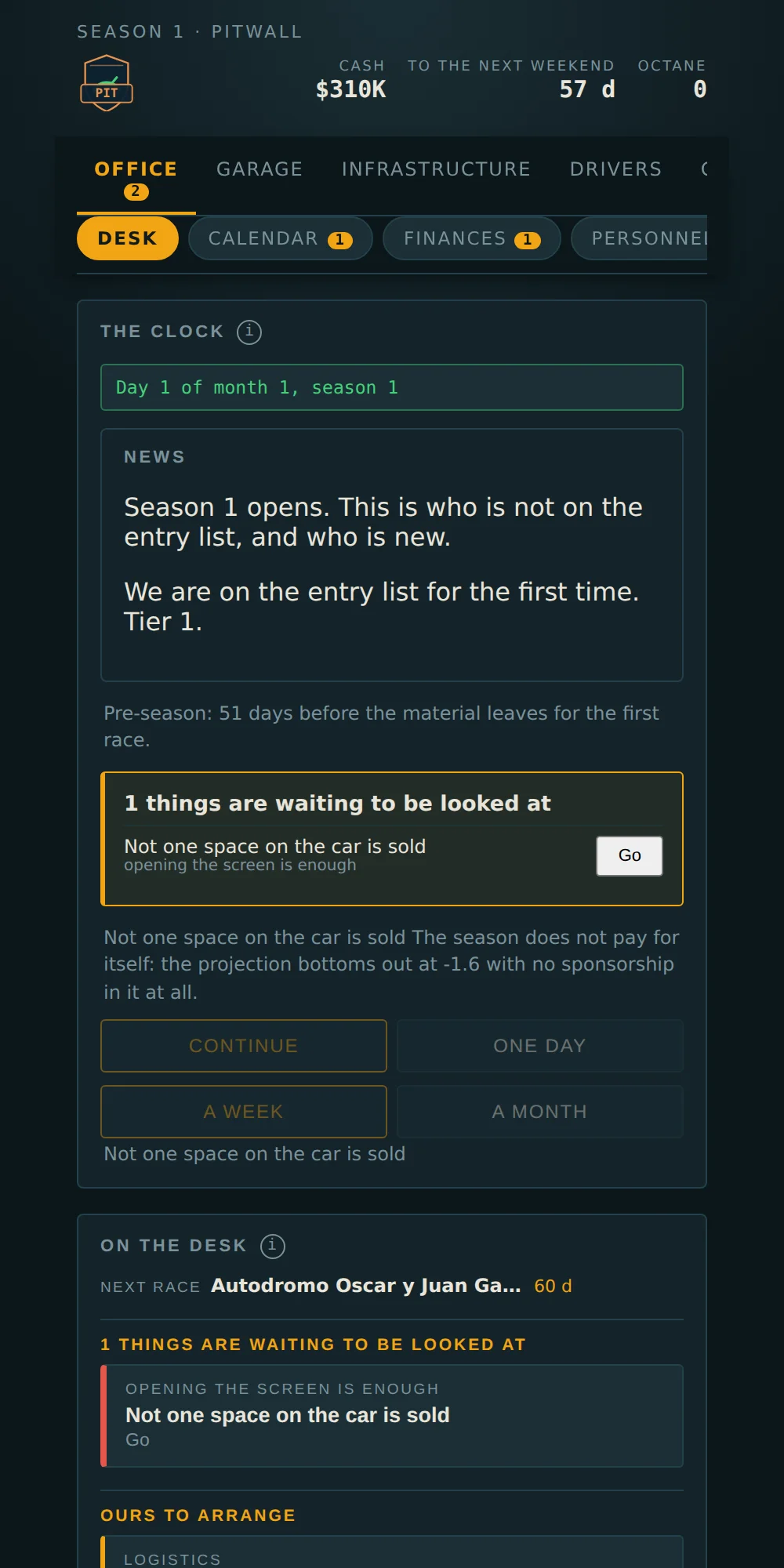
Not selling the spaces on the car. The finance director tells you outright when it happens: that is where a season is paid for.
Spending everything on promotion. The division above costs more to enter, and the fee is about a tenth of the budget: a promotion you cannot afford is a promotion that closes the team.
Skipping Friday. With no race-pace laps on a compound, Sunday's strategy projection is a guess — and every tyre reads the same, because you are guessing equally on all of them.
Spending the whole year on the car you already have. This year's aero, next year's car and correlation all draw on the same tunnel. A team that never sets hours aside for next year wins in March and disappears the following March.
Putting off services. It is a gamble, and a failure costs several times as much — always at the worst moment.
Treating an estimate as a fact. Every technical number has a band. When correlation is low that band is wide and always biased the same way: if you have developed three times in a row without finding the time you expected, the problem may not be the design — it may be the instrument measuring it.
First-season priorities
- Reach the end of the season solvent. Everything else comes after.
- Sell every sellable space and take support in kind where it is offered: under a cap it is worth more than revenue.
- Build the cheapest facility that unlocks a programme you actually need — not the most prestigious one.
- Use practice to learn the tyres, not to set a time.
- Read the error bands before the averages: they tell you how much to trust what you are reading.